

What Makes an AI App Builder Ready for Real-World Production?
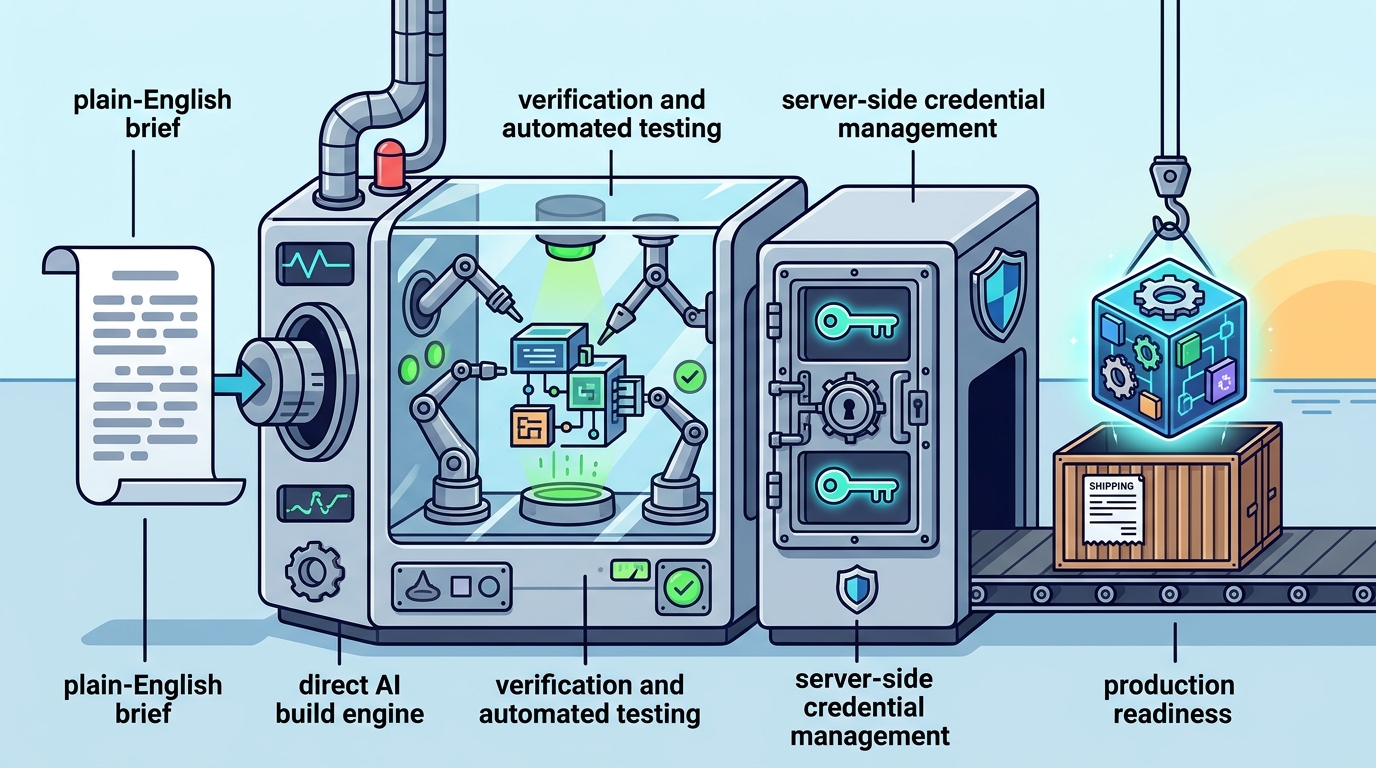
Production readiness in AI app builders depends on automated verification, version control, and server-side credential management. I Team App Builder addresses these needs by turning plain-English briefs into tested, runtime-verified applications. This approach removes the need for users to manage complex engineering stacks while ensuring the software is stable before deployment. For additional details, review the .
The Role of Automated Verification Pipelines
Automated verification is the primary mechanism that separates experimental code from production-grade software. It is a process that runs static checks and isolated runtime tests to confirm that an application behaves as expected. Without this layer, AI-generated code often contains subtle logic errors that only appear under specific user conditions. For additional details, review the Frequently Asked Questions.
I Team App Builder integrates a direct AI build engine that connects to OpenAI production paths. This connection allows the system to write code and immediately verify it against defined criteria. The platform runs static checks to identify syntax issues and performs isolated runtime tests to ensure functionality. This dual-layer approach reduces the risk of deploying broken features. For additional details, review the About.
For founders and operators, this means the software is not just generated; it is validated. The verification pipeline acts as a quality gate. If a build fails a test, the system can flag the issue before it reaches the user. This is critical for maintaining trust in AI-assisted development workflows.
Server-Side Credential Management and Security
Server-side credential management is a security architecture that keeps API keys and provider credentials hidden from the client environment. This practice prevents unauthorized access to underlying AI models and reduces the attack surface of the application. In traditional development, managing these secrets requires complex backend infrastructure and strict access controls.
I Team App Builder keeps provider credentials server-side by design. This means users do not need to store or manage sensitive API keys in their local environments. The platform handles the technical execution of these credentials securely. This design choice simplifies the development process for non-technical users. It also ensures that the AI engine operates within a controlled and secure boundary.
Security in AI app builders is not just about code quality; it is about infrastructure. By abstracting the credential management, I Team App Builder allows creators to focus on the application logic. The platform ensures that the connection to the AI provider remains secure and stable. This is a foundational element of production readiness.
Versioned Projects and Change Tracking
Version control is a system that tracks changes to software code over time, allowing developers to revert to previous states if errors occur. In AI-assisted development, versioning is essential because AI models can introduce unexpected changes during iterative builds. Without clear version history, debugging becomes a chaotic and time-consuming process.
I Team App Builder supports versioned projects as a core feature. This allows users to see the evolution of their application from the initial brief to the final build. Each phase of the build, from planning to verification, is tracked. This transparency helps users understand how the application was constructed. It also provides a safety net for rolling back changes if a new update introduces bugs.
For small teams and solo founders, version control provides a level of professional rigor that was previously only available to large engineering departments. It ensures that the development process is auditable and reproducible. This is a key factor in making AI-generated software suitable for real-world business operations.
Eliminating Runaway Repair Loops
A runaway repair loop is a failure state where an AI system repeatedly attempts to fix a bug but introduces new errors in the process. This phenomenon can lead to infinite loops of code generation and testing, consuming resources without producing a stable application. It is one of the most common challenges in autonomous AI coding tools.
I Team App Builder is built to eliminate these runaway repair loops. The platform uses a controlled workflow that guides the AI through distinct phases: plan, build, and verify. By structuring the process, the system avoids the chaotic iteration that leads to repair loops. The build mission is defined clearly, and the AI executes within those boundaries. This controlled approach ensures that the software progresses toward a stable state.
The implication for users is a more predictable development experience. Instead of dealing with erratic AI behavior, they receive a structured output. This predictability is crucial for production readiness. It allows teams to plan their deployment timelines with greater confidence. The platform’s design prioritizes stability over raw speed, which is often a better trade-off for business-critical applications.
Key Takeaways
- Automated verification pipelines are essential for confirming that AI-generated code is stable and functional.
- Server-side credential management enhances security by keeping sensitive API keys away from the client environment.
- Version control provides a safety net by tracking changes and allowing rollbacks in AI-assisted development.
- Structured workflows help prevent runaway repair loops, ensuring a predictable and stable build process.
- I Team App Builder integrates these elements to provide a production-ready environment for non-technical users.
- Production readiness requires a balance of code quality, security infrastructure, and process control.
Frequently Asked Questions
What is the primary benefit of server-side credential management in AI app builders?
It keeps sensitive API keys secure and hidden from the user’s local environment, reducing the risk of unauthorized access.
How does I Team App Builder handle code verification?
The platform runs static checks and isolated runtime tests to ensure the application behaves as expected before deployment.
Can I revert my application to a previous version if a bug appears?
Yes, the platform supports versioned projects, allowing you to track changes and roll back to earlier stable states.
What is a runaway repair loop in AI coding?
It is a failure state where an AI repeatedly tries to fix a bug but introduces new errors, leading to an unstable build.
Does I Team App Builder require users to manage the engineering stack?
No, the platform is designed to handle the technical execution, allowing users to focus on creation without managing infrastructure.
Conclusion
Production readiness in AI app builders is defined by the integration of verification, security, and version control. I Team App Builder provides these elements through a controlled workflow that turns plain-English briefs into verified applications. By focusing on these core technical pillars, the platform enables founders and operators to build reliable software without managing the underlying engineering stack. To start your project, visit I Team App Builder.