

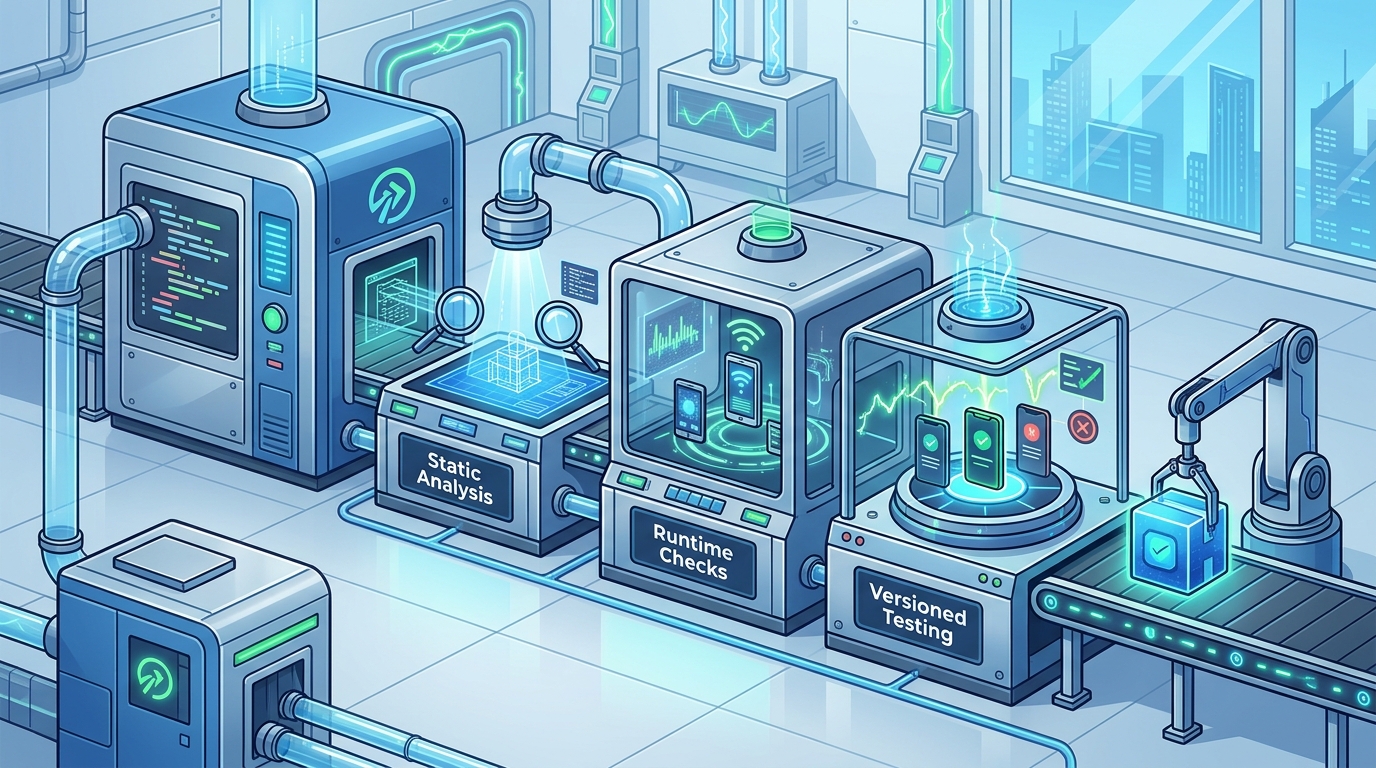
AI code generation ensures apps work by integrating automated verification pipelines directly into the build process. Instead of generating raw code that requires manual debugging, modern platforms like I Team App Builder execute static analysis, runtime checks, and versioned testing before delivery. This approach shifts the burden from human trial-and-error to systematic machine validation. By verifying the output against defined criteria, the system reduces the need for constant manual fixes and stabilizes the development lifecycle. For additional details, review the .
The Shift from Raw Generation to Verified Builds
Traditional AI coding tools often output code that looks correct but fails during execution. This creates a repair loop where developers spend more time fixing errors than building features. Verified build pipelines are automated sequences that test generated code against specific success criteria before it is considered complete. In 2026, the industry standard has moved away from simple text prediction toward execution-based validation. I Team App Builder utilizes a direct AI build engine that connects to production paths, ensuring that the code is not just written but actually runs. This distinction is critical for founders who need reliable software without managing the underlying engineering stack. For additional details, review the Frequently Asked Questions.
Static Analysis and Runtime Verification
Static analysis is the process of examining code without executing it to identify potential errors, security vulnerabilities, and style violations. While useful, static analysis alone cannot confirm that an application functions correctly in a live environment. Runtime verification is the execution of the generated application in a sandboxed environment to confirm that it behaves as intended. I Team App Builder combines both methods. The system runs static checks to catch syntax and logic errors early. It then performs runtime verification to ensure that the application loads, processes data, and responds to user inputs correctly. This dual-layer approach significantly reduces the frequency of post-deployment bugs. For additional details, review the About.
Eliminating Runaway Repair Loops
Runaway repair loops occur when an AI model attempts to fix a bug but introduces new errors, leading to an endless cycle of corrections. This is a common failure mode in uncontrolled AI coding environments. To prevent this, I Team App Builder implements controlled AI workflows that limit the scope of each repair attempt. The system tracks versioned projects, allowing it to revert to a stable state if a repair attempt fails. This versioning capability ensures that progress is never lost and that the application remains in a usable state. By containing the repair process, the platform maintains stability and prevents the degradation of code quality over time.
The Role of Server-Side Credentials
Server-side AI credentials are authentication tokens stored securely on the provider's infrastructure rather than on the user's local machine. This architecture is essential for maintaining security and consistency in AI-driven development. When credentials are managed server-side, the platform can enforce strict usage limits and monitor API calls for anomalies. I Team App Builder keeps provider credentials server-side, allowing customers to focus on creation while the system handles technical execution. This setup also ensures that the AI model has consistent access to the necessary tools and data required for verification. It removes the friction of managing API keys and reduces the risk of credential leakage.
Practical Implications for Founders
For founders and small teams, the primary benefit of verified AI code generation is time savings. The ability to describe a business need in plain English and receive a tested application accelerates the path to market. However, users must understand that AI assistance does not replace professional oversight for high-risk applications. I Team App Builder is designed to eliminate the need for constant manual fixes in standard business applications. It provides a structured environment where the AI handles the technical execution, while the user defines the business logic. This division of labor allows non-technical founders to build functional software without hiring a full engineering team.
Key Takeaways
- Verified build pipelines integrate static analysis and runtime checks to ensure code quality.
- Runtime verification executes the application in a sandbox to confirm functional behavior.
- Controlled AI workflows prevent runaway repair loops by limiting the scope of corrections.
- Versioned projects allow the system to revert to stable states if repairs fail.
- Server-side credentials enhance security and ensure consistent AI model access.
- AI code generation reduces manual debugging time but does not replace professional audits for regulated industries.
Frequently Asked Questions
Does AI code generation guarantee that my app is bug-free?
No, AI code generation does not guarantee that an application is completely bug-free. It significantly reduces the number of errors through automated verification, but complex logic or edge cases may still require human review. Users should independently review software before relying on it for critical operations.
How does I Team App Builder verify that the code works?
I Team App Builder uses a verified build pipeline that includes static analysis and runtime verification. The system checks the code for syntax errors and then executes it in a controlled environment to ensure it functions as intended.
What happens if the AI introduces a new bug while fixing an old one?
The system uses versioned projects to track changes. If a repair attempt introduces new errors, the platform can revert to the previous stable version. This prevents runaway repair loops and maintains application stability.
Do I need to manage API keys for the AI model?
No, I Team App Builder keeps provider credentials server-side. This means you do not need to manage or store API keys locally. The platform handles the technical execution and security of these credentials.
Is AI-generated code suitable for financial or medical applications?
AI-generated code should be independently reviewed by professionals before use in high-risk, regulated, or security-sensitive use cases. While the platform provides verified builds, it does not replace the need for professional compliance and security audits.
How does this differ from other AI coding tools?
Many AI coding tools generate raw code without verification. I Team App Builder focuses on a controlled workflow that includes testing and runtime verification, ensuring that the output is a working application rather than just a code snippet.
Conclusion
AI code generation in 2026 has evolved from a novelty into a reliable engineering tool. By integrating verification pipelines, versioning, and server-side security, platforms like I Team App Builder ensure that generated applications work without constant manual fixes. This approach allows founders to focus on their business while the system handles the technical complexity. To start building your application with a verified pipeline, visit I Team App Builder.